



RESNET Certified Inspector | Builder Focused Turnaround | Immediate Electronic Reports
Request Blower Door Testing
we respond quickly for Vero Beach blower door testing. no waiting days for scheduling and reports.
What Is a Blower Door Test?
For all new residential construction and additions in Vero Beach, Blower Door Testing is the code-required test used to verify that the home’s envelope is tight enough to satisfy Florida Energy Conservation Code standards.
As projects move through the final stretch of the job, builders need more than a visual assumption that the envelope is sealed correctly. The blower door test provides a measurable result that supports compliance and inspection readiness.
The test works by placing a calibrated fan in an exterior doorway and measuring the amount of air moving through the home under pressure. That reading is then used to determine whether the structure meets the required leakage limit in Vero Beach in accordance with FBC Section R402.1.4.2.
About Me
Before founding Stellar Building Performance, I spent more than 4 years overseeing residential energy code compliance services across two branches covering Southeast Florida including Vero Beach for a national engineering firm, supporting builders, contractors, and developers on projects ranging from single-family homes, to developments, to multifamily construction.
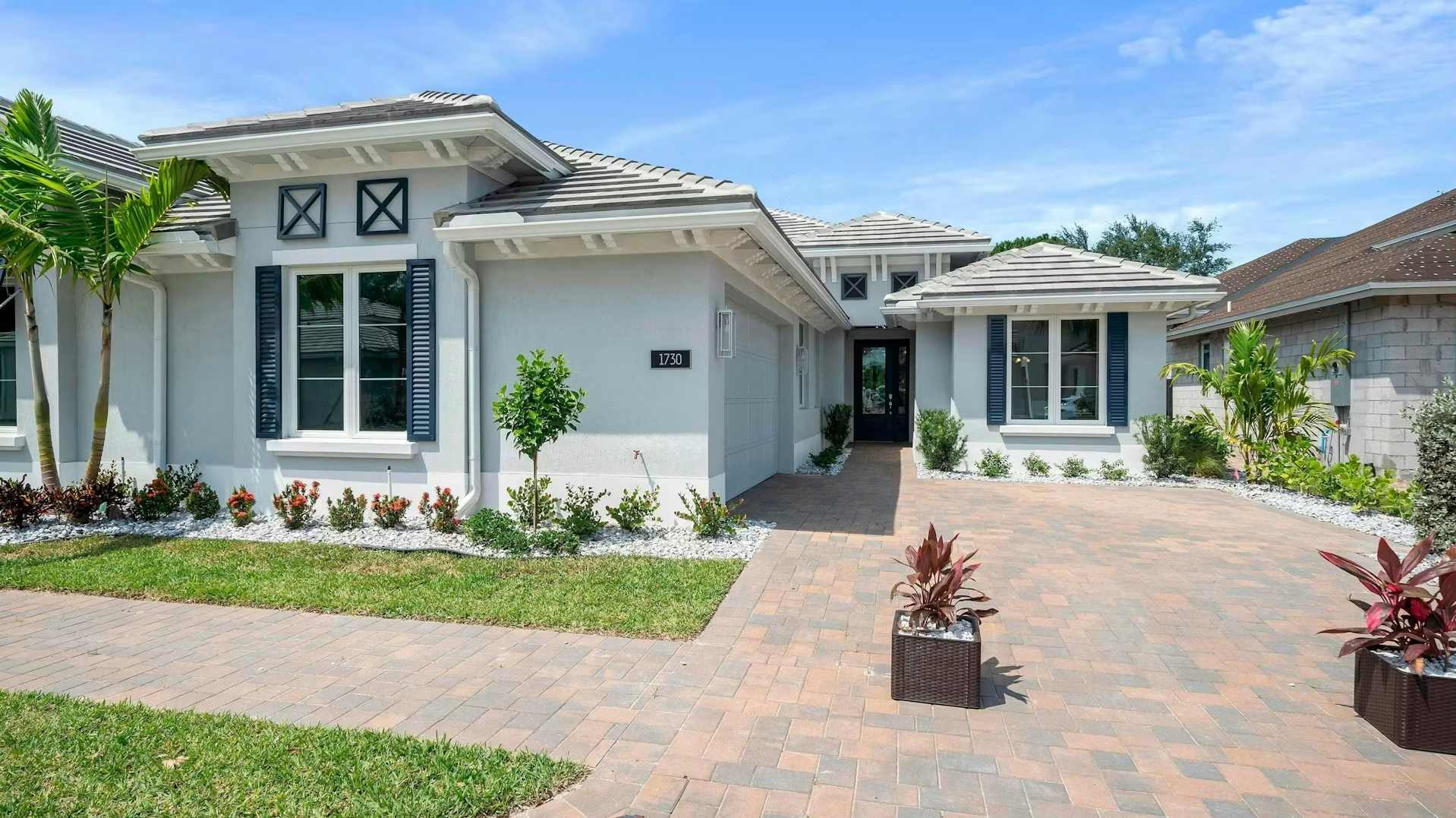
Local Vero Beach Projects I’ve Performed Blower Door Testing For



Florida Energy Code Blower Door Requirements
Florida energy code requires a verified envelope leakage result for all residential construction dwellings, which is why blower door testing remains an important step for builders in Vero Beach that need approval by the Indian River County Building Department.
Stellar Building Performance helps builders and contractors handling residential projects in Vero Beach complete that requirement with field-tested measurements and reporting prepared for code files, inspections, and local approval workflows.
Why is Blower Door Testing Beneficial?
In Vero Beach, blower door testing helps determine whether a home is in compliance with building code and not wasting energy on lost conditioned air.
Excessive air leakage can cause:
That extra verification supports quality control, improves confidence at closeout, and reduces the chance of paperwork or inspection issues showing up after the schedule is already tight.
How We Keep Our Services Simple and Easy
We keep the blower door testing process straightforward for Vero Beach builders so scheduling, testing, and reporting are easy to follow.
1.
Schedule your test
Once the home is ready, reach out with the project details and we’ll coordinate a blower door test for your Vero Beach job.
2.
onsite testing
We arrive with calibrated blower door equipment, set up at the home, and perform the required air leakage test.
3.
Diagnostics and Measurements
We record the leakage result and review whether the home is within the required range for residential code compliance.
4.
Report delivered same day via email
Your documentation is sent electronically immediately after the test, so you have what you need for records, inspections, and closeout paperwork.
5.
Ready for Final Inspection approval
With testing complete and the report in hand, your Vero Beach project is positioned for the next step in the final approval process.
Contact Us for Fast & Convenient Blower Door Testing in Vero Beach
Why Builders Choose Stellar Building Performance
Other Inspectors
You’re just another sale
Stellar Building Performance
No missed appointments or reschedules.
Responsive scheduling for Vero Beach projects.
We’re on the same team
Frequently asked questions about Blower Door Testing
Builders in Vero Beach should generally plan on about 30 to 60 minutes for a standard blower door test. The appointment can vary depending on the home’s size and whether the jobsite is fully prepared when testing begins.
Residential projects in Vero Beach that include conditioned living space always require blower door testing. This can include detached homes, townhomes, duplexes, apartments, additions, and related residential structures.
Common Structures Like:
Additional Structures Like:
Most builders in Vero Beach schedule blower door testing once the envelope is complete and the job is getting close to final inspection. It is generally treated as a late-stage compliance item, not an early construction task.
A missing blower door report can and will hold up final approval in Vero Beach until the measurement is completed and submitted. It is a required inspection item.
Not 100% complete in every cosmetic detail, but complete enough that the building envelope is representative of the finished home. Windows, doors, and penetrations should already be installed and sealed before testing takes place. We generally recommend having your inspection within a few days of requesting final inspection.
Not usually. People can remain on the project, but the house needs to stay in the proper testing condition while the blower door fan is running. Doors and windows must remain closed. We coordinate with anyone onsite, so the process stays efficient.
Blower Door Testing Code Reference
Blower Door Test Florida Requirements Explained
Builders and contractors in Vero Beach can use this section as a plain-language starting point for understanding how blower door testing fits into Florida’s residential energy code. Stellar Building Performance performs blower door testing in Vero Beach with the code requirements in mind and can help answer questions about how those sections apply to active projects. Blower Door Testing has been required for all residential dwellings in Vero Beach since the introduction of the 2017 Florida Building Code for Energy Conservation Sections R402-R405. Our specialists are experts on the building codes and can answer any questions you may have about the codes, but feel free to read excerpts from the current building code, 2023 Florida Building Code, Energy Conservation, Eighth Edition, below.
Questions about code requirements? Call us.
This code line explains testing procedures and Prescriptive Path air leakage requirements.
R402.4.1.2 Testing.
The building or dwelling unit shall be tested and verified as having an air leakage rate not exceeding seven air changes per hour in Climate Zones 1 and 2, and three air changes per hour in Climate Zones 3 through 8. Dwelling units with an air leakage rate less than three air changes per hour shall be provided with whole-house mechanical ventilation in accordance with Section R403.6.1 of this code and Section M1507.3 of the Florida Building Code, Residential. Testing shall be conducted in accordance with ANSI/RESNET/ICC 380 and reported at a pressure of 0.2 inch w.g. (50 pascals). Testing shall be conducted by either individuals as defined in Section 553.993(5) or (7), Florida Statutes, or individuals licensed as set forth in Section 489.105(3)(f), (g) or (i) or an approved third party. A written report of the results of the test shall be signed by the party conducting the test and provided to the code official. Testing shall be performed at any time after creation of all penetrations of the building thermal envelope.
Exception: Testing is not required for additions, alterations, renovations or repairs of the building thermal envelope of existing buildings in which the new construction is less than 85 percent of the building thermal envelope.
During testing:
1.Exterior windows and doors, fireplace and stove doors shall be closed, but not sealed, beyond the intended weatherstripping or other infiltration control measures.
2.Dampers including exhaust, intake, makeup air, backdraft and flue dampers shall be closed, but not sealed beyond intended infiltration control measures.
3.Interior doors, if installed at the time of the test, shall be open.
4.Exterior doors for continuous ventilation systems and heat recovery ventilators shall be closed and sealed.
5.Heating and cooling systems, if installed at the time of the test, shall be turned off.
6.Supply and return registers, if installed at the time of the test, shall be fully open.
7.If an attic is both air sealed and insulated at the roof deck, interior access doors and hatches between the conditioned space volume and the attic shall be opened during the test and the volume of the attic shall be added to the conditioned space volume for purposes of reporting an infiltration volume and calculating the air leakage of the home.
This code line explains result requirements under the most common energy code compliance path in Florida, the Performance Path.
R405.2.2 Building air leakage testing.
Building or dwelling air leakage testing shall be in accordance with Sections R402.4 through R402.4.1.2. If an air leakage rate below seven air changes per hour at a pressure of 0.2 inch w.g. (50 pascals) is specified for the proposed design, testing shall verify the air leakage rate does not exceed the air leakage rate of the proposed design instead of seven air changes per hour.
In some instances, to comply with building code, your project may require additional testing. Compliance documents required as part of your permit package, commonly called Energy Calculations, determine code requirements for your specific project. These code lines outline Duct Leakage Test requirements. We can test this while onsite for your Blower Door Test if it is required.
R403.3.3 Duct testing (Mandatory).
Ducts shall be pressure tested to determine air leakage by one of the following methods:
1.Rough-in test: Total leakage shall be measured with a pressure differential of 0.1 inch w.g. (25 Pa) across the system, including the manufacturer’s air handler enclosure if installed at the time of the test. All registers shall be taped or otherwise sealed during the test.
2.Postconstruction test: Total leakage shall be measured with a pressure differential of 0.1 inch w.g. (25 Pa) across the entire system, including the manufacturer’s air handler enclosure. Registers shall be taped or otherwise sealed during the test.
Exceptions:
1.A duct air leakage test shall not be required where the ducts and air handlers are located entirely within the building thermal envelope.
2.Duct testing is not mandatory for buildings complying by Section R405 of this code. Duct leakage testing is required for Section R405 compliance where credit is taken for leakage, and a duct air leakage Qn to the outside of less than 0.080 (where Qn = duct leakage to the outside in cfm per 100 square feet of conditioned floor area tested at 25 Pascals) is indicated in the compliance report for the proposed design.
A written report of the results of the test shall be signed by the party conducting the test and provided to the code official.
R405.2.3 Duct air leakage testing.
In cases where duct air leakage lower than the default Qn to outside of 0.080 (where Qn = duct leakage to the outside in cfm per 100 square feet of conditioned floor area tested at 25 Pascals) is specified for the proposed design, testing in accordance with Section R403.3.2 shall verify a duct air leakage rate not exceeding the leakage rate of the proposed design. Otherwise, in accordance with Section R403.3.3, duct testing is not mandatory for buildings complying by Section R405.
Need Blower Door Testing in Vero Beach to Pass Final Inspection?
Similar Services
Stellar Building Performance specializes in building performance diagnostics.
Duct Leakage Testing
Verify duct system airtightness using professional duct blaster testing required for new construction inspections.
Energy Code Calculations
Energy performance calculations required for Florida residential building permits and code compliance documentation.
Helping Vero Beach Builders Stay on Schedule
Fast Scheduling
Builders get testing scheduled quickly to avoid delays.
accurate results
Professional equipment ensures reliable measurements.
immediate reports
Documentation provided immediately by email for inspection approvals.
Other Areas We Serve
Local blower door testing in Vero Beach, with additional service throughout Brevard County, Indian River County, and St. Lucie County.
